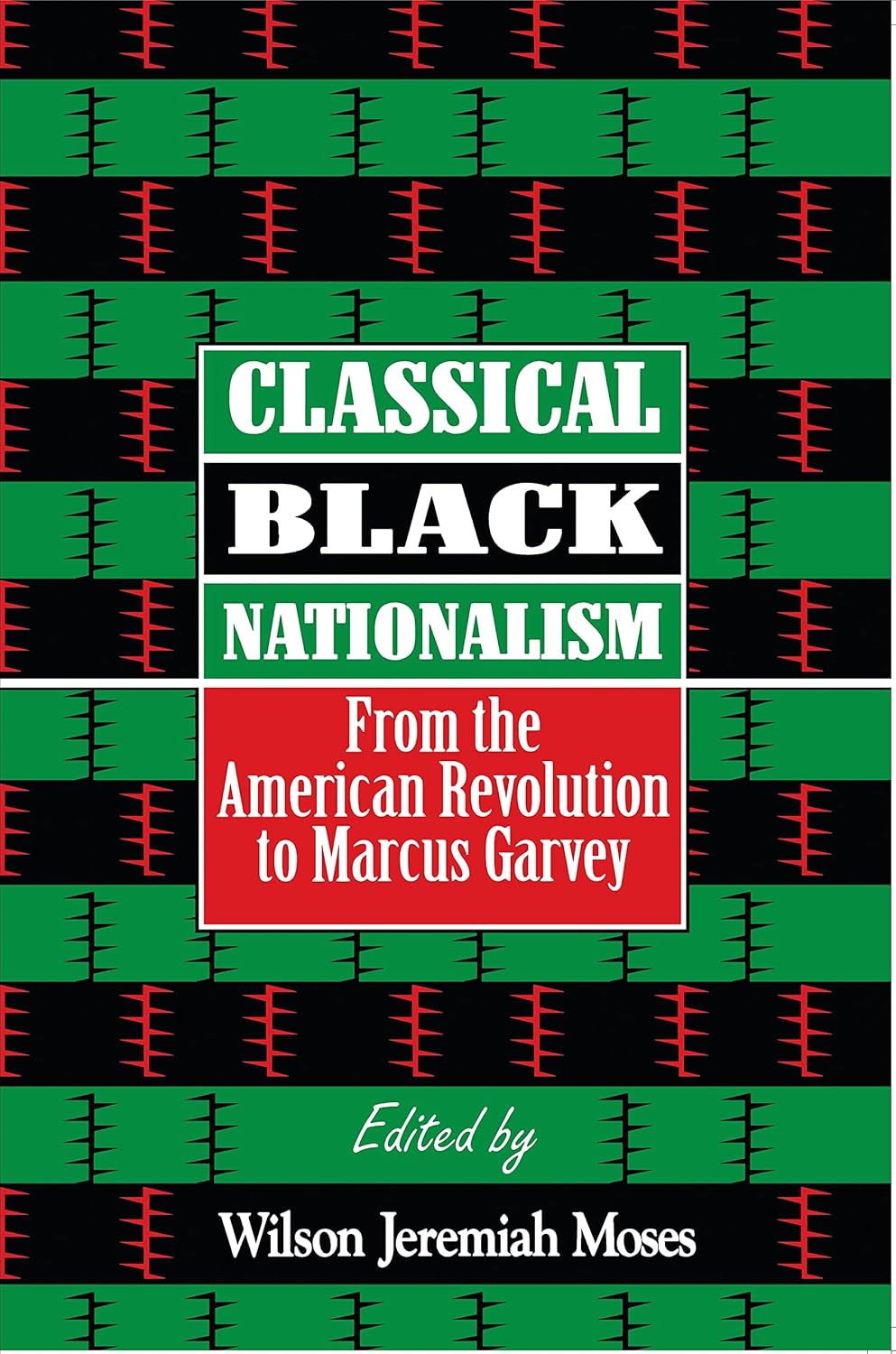
Classical Black Nationalism: From the American Revolution to Marcus Garvey
Item
-
Title
-
Classical Black Nationalism: From the American Revolution to Marcus Garvey
-
This edition
-
"Classical Black Nationalism: From the American Revolution to Marcus Garvey." Ed. Wilson Jeremiah Moses. New York: NYU Press, 1996. 257 pp.
-
Online access
-
JSTOR (subscription required)
-
JSTOR
-
Table of contents
-
[authors marked with an asterisk (*) are not African American]
● Wilson J. Moses / Introduction
One. The Colonization and Emigration Controversy, Preclassical Period.
● Thomas Jefferson* / Notes on the State of Virginia, 1781-1782 (excerpt)
● Paul Cuffe / Letters to Peter Williams Jr. (1816) and James Forten (1817)
● James Forten / Letter to Paul Cuffe (1817)
● Anon. / Mutability of human affairs (1827)
● Robert Alexander Young / The Ethiopian Manifesto (1829)
● David Walker / An Appeal in Four Articles (1830)
● Maria Stewart / Address at the African Masonic Hall (1833)
Two. Classical Black Nationalism, 1850-62.
● Martin R. Delany / The Condition, Elevation, Emigration, and Destiny of the Colored People of the United States (1852)
● Roger B. Taney* / Obiter dictum on the Dred Scott Case (1857)
● James T. Holly / A Vindication of the Capacity of the Negro Race for Self-Government and Civilized Progress (1857)
● Frederick Douglass / African Civilization Society (1859)
● Henry Highland Garnet / Address at Cooper's Institute (1860)
● Martin R. Delany / Official Report of the Niger Valley Exploring Party (1861)
● Alexander Crummell / The Progress of Civilization along the West Coast of Africa (1861)
● Edward Wilmot Blyden / The Call of Providence to the Descendants of Africa in America (1862)
● Abraham Lincoln* / Address on Colonization to a Deputation of Colored Men (1862)
● Daniel A. Payne / An Open Letter to the Colored People (1862)
Three. Black Nationalist Revival, 1895-1925.
● Henry McNeal Turner / The American Negro and His Fatherland (1895)
● W. E. B. Du Bois / The Conservation of Races (1897)
● Marcus Garvey / Address at Newport News (1919)
Index
-
About the anthology
-
● Includes a long introductory essay by Moses, as well as the chronologically-arranged selection of texts and documents primarily from black nationalist spokespersons.
-
● See also the companion volume, "Modern Black Nationalism: From Marcus Garvey to Louis Farrakhan," ed. William L. Van Deburg (1997)
-
Publisher's description
-
"Examines the evolution of black nationalist thought from its earliest proto-nationalistic phase in the 1700s to the Garvey movement in the 1920s. Recent years have seen a resurgence of interest in modern black nationalist leaders such as Stokely Carmichael and Malcolm X. But what of the ideological precursors to these modern leaders, the writers, and leaders from whose intellectual legacy modern black nationalism emerged? Wilson Jeramiah Moses, whom the Village Voice called one of the foremost historians of black nationalism, has here collected the most influential speeches, articles, and letters that inform the intellectual underpinnings of contemporary black nationalism, returning our focus to black nationalism at its inception.
The goal of early black nationalists was the return of the African-American population to Africa to create a sovereign nation-state and to formulate an ideological basis for a concept of national culture. Most early black nationalists believed that this return was directed by the hand of God. Moses examines the evolution of black nationalist thought through several phases, from its proto-nationalisic phase in the late 1700s through a hiatus in the 1830s, through its flourishing in the 1850s, its eventual eclipse in the 1870s, and its resurgence in the Garvey movement of the 1920s.
Moses provides us with documents that illustrate the motivations of both whites and blacks as they sought the removal of the black population. We hear from Thomas Jefferson, who held that it was self-evident that black and white populations could not intermingle on an equal basis or merge to form one happy society, and who toyed with the idea of a mass deportation of the black American population. We see that the profit motive is an important motive behind any nationalist movement in the letters between African American capitalists Paul Cuffe and James Forten. Among the more difficult selections to classify in this collection, Robert Alexander Young's Ethiopian Manifesto prophesied the coming of a prophetic liberator of the African race. The Christian nature of nineteenth century black nationalism is evident in Blyden's The Call of Providence.
Moses rounds out the volume with contributions from more well- known voices such as those of Marcus Garvey, W.E.B. Dubois, and others. Classical Black Nationalism will serve as a point of departure for anyone interested in gaining a foundational knowledge of the disparate voices behind this often discussed but seldom understood movement."
-
Reviews and notices of anthology
-
● Reed, Harry A. "H-Review" (Nov. 1996). Web.
"Moses is presenting this work, not as a scholarly edition, but as a teaching text. . . . As such, this volume is a welcome addition to his scholarly work on the topic."
Offers "a slight rethinking and modification of some of his ideas" in his classic "The Golden Age of Black Nationalism, 1850-1925" (1978). Moses writes as one committed to the separatist vision of black nationalism and his account of black nationalism is narrower than that offered in the anthology edited by Bracey, Meier, and Rudwick, "Black Nationalism in America" (1970).
-
H-Review
-
Item Number
-
A0622
 Modern Black Nationalism: From Marcus Garvey to Louis Farrakhan
 Front cover